Saturday, January 10, 2015

Recorder resources and songs

First of all, it's important to play the recorder properly:https://www.youtube.com/watch?v=weh4Omts-EE


I think the recorder is the instrument of the devil, capable of inflicting pain in small, furry rodents within a 50 miles radius.  However, when it's not engaged in evil deeds, it is an invaluable part of the general music class.  Here's why: 1. Playing affords melodic reading experience  2. Playing improves fine and gross motor coordination 3. They provide beginning wind instrument experience 4. They're cheap 4. They're portable and durable. Even my students who inadvertently try to murder them or inflict bite marks on them still only break about 1 a year.   5. Recorder instruction allows a lot of differentiation, whether you use recorder karate or other individual student-paced curriculum. 6.If the United States decided to have a mass concert of Hot Cross Buns, at least 99% of the general population would be able to participate.

My population is very transient and often I can not teach more than GAB, but I get a lot of out of those 3 notes.  I know some teachers start with A and C and do a lot of sol-mi music that way, but since I don't teach in Hungary and live in a country with mi-re-do music, that's what I'm going to focus on.  I'm sorry if I just made many Kodaly people's heads explode.

I used to do recorder in 3rd grade, but my students are no longer able developmentally to handle the fine and gross motor skills, so I've pushed it up to 4th grade.  Five years ago my students were clamoring to earn belts.  About a year ago I noticed the interest was flagging and now I have to practically offer to give away an Oldsmobile to get them to buy into home practice.  But there are a few who want to accelerate so I still do recorder karate with them.  I make a big deal by having belts announced over the intercom and giving them certificates, but the students give up after the yellow belt.  

To differentiate I use recorder karate.  If you don't want to pay for the kit, it's still easy to implement on your own.  You can choose music that gets increasingly more difficult and tie string or yarn or whatever you have on hand around the recorders.  The advantage to recorder karate is that there's already a website for practice, but with today's technology, it's easy to make your own accompaniments.
The other way I differentiate is by writing alternate parts.

Fun recorder activities:
I use three hula hoops --different colors--to represent GAB.   I step into one and the students play that note.  I demonstrate several different ways to "conduct" and then let them take turns.  The first few students will do random jumping but along the way the students start to change from playing with their hair on fire to thinking about melodic ideas.  There will always be a kid who thinks it's fun to run back and forth and do silly stuff so I ask the class to assess that type of activity.  Then the next student invariably will start to become more purposeful and the class continues to assess the performance.  Gradually the students will discover that when they end on G it sounds good and finally a little bulb will go off and one will pipe up and say, "Hey--that's mi re do."

Reaction game:
Snap =A
Clap =B
Pat = G
after rehearsing for a while, I can teach GAB songs using the body percussion.  I choose student volunteers when they feel secure enough to try it.

Here are some of the songs I use with the recorder
Joy to the World (Three Dog Night version)  uses G and A on refrain
Old Brass Wagon from Silver Burdett

y q’ q q’  y q’ q q’ y q’ q q’ q q
gggg     g        g    g           a a a a   a         a     a       b b b b  b          b       b         a     b

q q]
g     g
if you don't have the music from Silver Burdett--just modify the second to last measure to a a 
The Silver Burdett recording is a lot of fun and the students enjoy it.


Pizza Pizza Daddy-o from Silver Burdett

Play G for the response using the same rhythm.  The students LOVE the game that goes with it because you get to say that someone has a boy/girlfriend.  
Chicken on a Fence Post 
Play G on the 16th notes of song


Draw Me a Bucket of Water.  I use the Silver Burdett version but if you don't know it
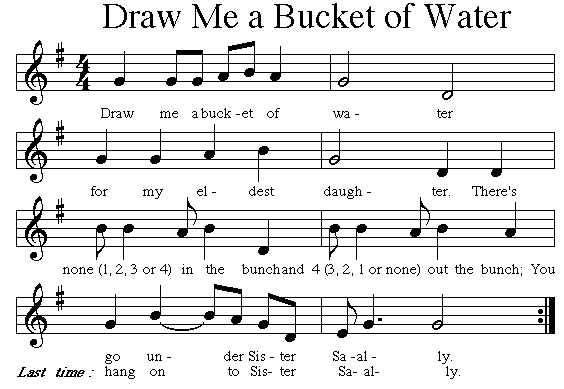
I have the students play play a G instead of D in the second, fourth, sixth and seventh measures and G for the E on the last measure.  And if you want to differentiate, play it as is.


Friday, January 2, 2015

Using serious and authentic music in the classroom

  
My theory about how we experience music can be found in another blog post so I won't go into it here. I'll just summarize it this way: Moving to music, is one of the best, if not the best, ways to initially experience music. Movement can mean using the body to physically respond to the music using form and expressionist qualities of the music to guide the patterns.  It can also include simple body percussion patterns to reinforce elements such as meter or tempo or accompanying the piece with simple rhythmic or melodic patterns. 

Rhythm cards.  I have sets of rhythm cards for all meters.   Below is how I used them for Anitra's Dance from the Peer Gynt Suite.  Anitra's Dance is in triple meter, which is sometimes underrepresented in music classes so I make sure to include several selections through out the year.  The process below can be used with any piece of music.  Embedded are two assessments: one individual and one group. 

First time we listen to the piece I have them perform a simple body percussion--pat clap clap.  Follow-up questions:
1. What did you notice about the tempo in some sections?  When I can elicit the proper response (tempo slows down) we talk a little bit about ritards.
2.  What did you notice about the dynamics? (Loud and softer sections, crescendo,    decrescendo)
3. Did any of the music sections return?  We talk about the formal structure. ABA
4. Were the beats grouped in twos or threes?
Next I illicit some suggestions for another body percussion pattern we can do for the B section and perform it again.
Now I place my rhythm cards in a circle and have the students sit behind a card and hand out chopsticks. (I like the soft sound they make).  I play a rhythm on one of the cards and that student (or students) have to play it back to me.  That way I check for understanding and do a quick assessment.  Next I ask if there is a card whose rhythm is also the beat.  We talk a little bit about the difference between beat and rhythm and refer back to the B section where the rhythms are faster but the beat remains the same.  Next the students tap out the patters on their cards 3x and move to the next card on the fourth time.  Repeat until the end of the piece.


Patterned movement
You can see some of my activities in the video section of the blog.  I use John Feierabend's Move It dvd series as a jumping off point.  I found many of the movements too balletic for my students and I ended up doing my own movements to make sense for my classroom needs.

Play along rhythms.
I have a lot of play along rhythms you can download in my free download section  Sometimes I write accompanying patterns and sometimes I use the rhythms found in a piece.  It all depends on what I'm trying to teach.


Composing
I have a variety of teacher-made manipulatives for rhythmic composing.  I made some heart beat rhythm figures that you can view in my free downloads section.  I ask the students to compose simple rhythmic patterns and have them use body percussion or small classroom percussion instruments to accompany the piece we're listening to.  Sometimes I will have them decode a rhythm pattern from the piece--for example, the second movement of Beethoven's  7th symphony has an ostinato pattern that's fairly easy to decode  as does the ostinato from Hall of the Mountain King, and see how many times they can hear that pattern.

Sing along motives:


A.      My students hate to sing, but if it’s short and catchy enough, they will join in: for example, singing Frere Jacques in the minor mode from Mahler’s Symphony No 1; the ground bass ostinato from Pachelbel’ infernal canon—you could also compare it to George winston’s variation.  If you want more songs based on that canons:
All together now" by The Farm
"Basket Case" by Green Day
"Bush" by Machine Head
"Cryin" by Aerosmith
"Domain" on the album "Lifeforms" by The Future Sounds of London
"Don't let it be love" by Bowling for Soup
"End Transmission" album by Snapcase, a band from Buffalo New York (2002)
"Graduation (Friends forever)" by Vitamin C (1999)
"Hook" by Blues Traveler
"I should be so lucky" by Kylie Minogue inspired by Canon
"I'll C U when U get there" by Coolio
"Ladies and gentlemen we are floating in space" by Spritiualized
"Let it be" by The Beatles
"Push" by Matchbox 20
"No woman, No cry" by Bob Marley
"On & On & On" by Catch 22 uses chords similar to those in Canon in D Major (1998)
"One Tin Soldier" by Coven
"Piano Love Songs" by pianist Bradley Joseph (2006)
"Rain and Tears" by Aphrodite's Child based on Canon in D mayor (1968)
Rick Wakeman from the band Yes performs Canon in D on their Wakeman 2000 DVD (2000)
"Rocket Surgery" by Amy Kuney
"Salve Regina" by All Angels
"Sk8ter boy" by Avril Lavigne
"Streets of London" by Roger Whittaker
"Torn" by Natalie Imbruglia
"Tunnel of Love" by Dire straits (1980)
"Valley of the Damned" by Dragonforce
"Welcome to the black parade" by My Chemical Romance
"We're not gonna take it" by Twisted Sister
"With or without you" by U2
B.      Melodic play alongs—use tone bells/ xylophones/boomwhackers/ whatever’s on hand.  Find a short melodic ostinato to play just as you would a singing part

Activities:
Turkish March
This is a favorite piece for all grades, k-5.
1.  in scattered formation I alternate between loco and non-locomotive movement for the A and B sections.  On the coda I do something a little different that reflects the upward melodic movement.
The younger students love to jump or skip but the older ones prefer marching.

2.  discussion about the two types of movement and the pattern in the music (AB coda)

3.  I ask the students to show me their loco and non-locomotive movements and we perform the piece again.

4.  transfer A section to triangles.  I use triangles because the piece uses a triangle.   I introduce triangles in kindergarten, but there are many students who have never used them before.
On the B section I conduct with the triangle mallet and on the coda we play the inside of the triangle.